Problem () Find a sufficient condition for a straight -stage graph to be rearrangeable. In particular, what about a straight uniform graph?
Conjecture () Let be a simple regular ordered -stage graph. Suppose that the graph is externally connected, for some . Then the graph is rearrangeable.
Question Is the binary affine cube the only 3-connected matroid for which equality holds in the bound where is the circumference (i.e. largest circuit size) of ?
Problem Let be natural numbers with . It follows from the pigeon-hole principle that there exist distinct subsets with . Is it possible to find such a pair in polynomial time?
Conjecture If is a finite field with at least 4 elements and is an invertible matrix with entries in , then there are column vectors which have no coordinates equal to zero such that .
Given integers , the 2-stage Shuffle-Exchange graph/network, denoted , is the simple -regular bipartite graph with the ordered pair of linearly labeled parts and , where , such that vertices and are adjacent if and only if (see Fig.1).
Given integers , the -stage Shuffle-Exchange graph/network, denoted , is the proper (i.e., respecting all the orders) concatenation of identical copies of (see Fig.1).
Let be the smallest integer such that the graph is rearrangeable.
Conjecture If is a non-empty graph containing no induced odd cycle of length at least , then there is a -vertex colouring of in which no maximum clique is monochromatic.
Let be a set, be the set of filters on ordered reverse to set-theoretic inclusion, be the set of principal filters on , let be an index set. Consider the filtrator .
Conjecture If is a completary multifuncoid of the form , then is a completary multifuncoid of the form .
See below for definition of all concepts and symbols used to in this conjecture.
Refer to this Web site for the theory which I now attempt to generalize.

 login/create account
 ) Find a sufficient condition for a straight
  -stage graph to be rearrangeable. In particular, what about a straight uniform graph?
  ) Let
) Let  be a simple regular ordered
  -stage graph. Suppose that the graph
  is externally connected, for some
  . Then the graph
  is rearrangeable.
  and a function
  such that if
  , then every saturated
  -Sperner system
  has cardinality at least
  ?
?  .
.  be integers. Set
  and
and  for
for  . Eventually we have
  ; put
; put  .
.
 , since
  ,
,  ,
,  ,
,  ,
,  ,
,  ,
,  ,
,  .
. .
. be a 3-regular graph that contains no cycle of length shorter than
  . Is it true that for large enough~
 ?
?  such that every
  -vertex
  -minor-free graph has at most
  cliques?
  denote ''
 divides
  ''. The mimic function in number theory is defined as follows [1].
 divisible by
  , the mimic function,
  , is given by,
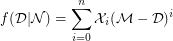
 is defined to be the mimic number of any positive integer
  .
.  the only 3-connected matroid for which equality holds in the bound
  where
where  is the circumference (i.e. largest circuit size) of
  ?
?  be natural numbers with
  . It follows from the pigeon-hole principle that there exist distinct subsets
  with
with  . Is it possible to find such a pair
  in polynomial time?
  , there is an integer
  so that every strongly
  -connected finite graph, is there an assignment of lengths
  to the edges of
  -
- (mod
(mod  ) for every vertex
  .
.  is a finite field with at least 4 elements and
  is an invertible
  matrix with entries in
  which have no coordinates equal to zero such that
  .
.  , the 2-stage Shuffle-Exchange graph/network, denoted
  , is the simple
  of linearly labeled parts
  and
and  , where
  , such that vertices
  and
and  are adjacent if and only if
  (see Fig.1).
 , the
, the  -stage Shuffle-Exchange graph/network, denoted
  , is the proper (i.e., respecting all the orders) concatenation of
  identical copies of
  be the smallest integer
  such that the graph
  .
.  of co-prime positive integers
  for
for  .
.  . In other words, simplify this formula.
  , then there is a
  contains every 2-regular graph on
  vertices as a minor.
  be a set,
  be the set of filters on
  be the set of principal filters on
  .
. is a completary multifuncoid of the form
  , then
  is a completary multifuncoid of the form
  .
.  is for every sets
  Drupal
 CSI of Charles University