Conjecture For every fixed graph , there exists a constant , so that every graph without an induced subgraph isomorphic to contains either a clique or an independent set of size .
Conjecture \item If is a countable connected graph then its third power is hamiltonian. \item If is a 2-connected countable graph then its square is hamiltonian.
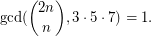
Conjecture There is a finite upper bound on the multiplicities of entries in Pascal's triangle, other than the number .
The number appears once in Pascal's triangle, appears twice, appears three times, and appears times. There are infinite families of numbers known to appear times. The only number known to appear times is . It is not known whether any number appears more than times. The conjectured upper bound could be ; Singmaster thought it might be or . See Singmaster's conjecture.
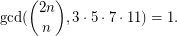
Problem (2) Find a composite or which divides both (see Fermat pseudoprime) and the Fibonacci number (see Lucas pseudoprime), or prove that there is no such .
Conjecture Let be an integer. For every integer , there exists an integer such that for every digraph , either has a pairwise-disjoint directed cycles of length at least , or there exists a set of at most vertices such that has no directed cycles of length at least .
Problem Let be natural numbers with . It follows from the pigeon-hole principle that there exist distinct subsets with . Is it possible to find such a pair in polynomial time?
Problem What is the maximum number of colours needed to colour countries such that no two countries sharing a common border have the same colour in the case where each country consists of one region on earth and one region on the moon ?
Problem () Find a sufficient condition for a straight -stage graph to be rearrangeable. In particular, what about a straight uniform graph?
Conjecture () Let be a simple regular ordered -stage graph. Suppose that the graph is externally connected, for some . Then the graph is rearrangeable.
A covering design, or covering, is a family of -subsets, called blocks, chosen from a -set, such that each -subset is contained in at least one of the blocks. The number of blocks is the covering’s size, and the minimum size of such a covering is denoted by .
Problem Find a closed form, recurrence, or better bounds for . Find a procedure for constructing minimal coverings.

 login/create account
 always rational?
  , there exists a constant
  , so that every graph
  without an induced subgraph isomorphic to
  .
.  . Does the fragment
  have the finite model property?
  is the minimum number
  for which there exists a polytope
  with
with  with
with  .
. , a convex polygon on
  ?
?  denote the pebbling number of a graph
  .
. 
 -diregular if every vertex has indegree and outdegree at least
  , every
  -diregular oriented graph on at most
  vertices has a Hamilton cycle.
  .
.  appears once in Pascal's triangle,
  appears twice,
  appears three times, and
  appears
  times. There are infinite families of numbers known to appear
  times is
  . It is not known whether any number appears more than
  . See
. See  or
or  which divides both
  (see
(see  (see
(see  -regular graph, where
  , then
  has chromatic number at most
  .
.  be an integer. For every integer
  , there exists an integer
  such that for every digraph
  , either
  , or there exists a set
  of at most
  vertices such that
  has no directed cycles of length at least
  contains every 2-regular graph on
  vertices as a minor.
  be natural numbers with
  . It follows from the pigeon-hole principle that there exist distinct subsets
  with
with  . Is it possible to find such a pair
  in polynomial time?
  and a function
  such that if
  , then every saturated
  has cardinality at least
  ?
?  be an indexed family of sets.
 for
for  .
. on the lattice
  of all finite unions of products.
 a bijection from hyperfuncoids
  defining the inverse bijection? If not, characterize the image of the function
  of complements of elements of the set
![$ p \in [0,1] $](/files/tex/1d076f7332523eb59bd7deae19667f83f0a3b6e0.png) , we let
, we let  denote a subgraph of
  .
. so that
  ?
?  ) Find a sufficient condition for a straight
  ) Let
) Let  be a simple regular ordered
  is externally connected, for some
  . Then the graph
  is rearrangeable.
  covering design, or covering, is a family of
  -set, such that each
  .
. . Find a procedure for constructing minimal coverings.
  , then
  cycles of length
  .
.  is for every sets
  and
and  Drupal
 CSI of Charles University